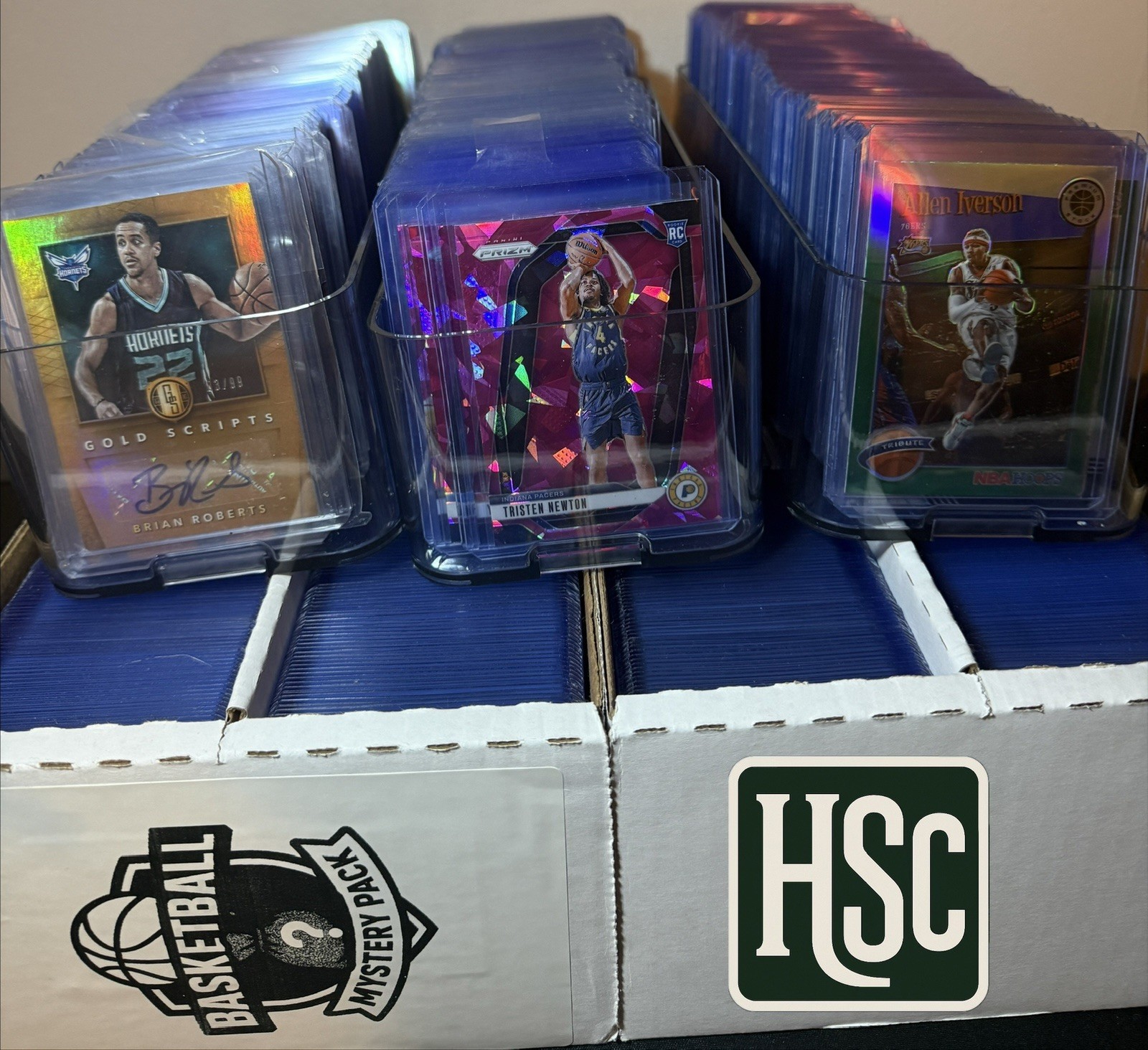

Photos from current listings. Actual item, color, and included accessories may vary.
Rookie Nba Card Buying Guide
Rookie NBA cards are cards featuring a player's first professional season, and the category spans base rookies, refractors, parallels, autographs, and memorabilia relics. The core trade-off is print run rarity and condition versus raw volume: bulk lots deliver quantity and set-building fun, while single serial-numbered or autographed rookies drive long-term value. The decision rule is simple: buy singles with visible centering, corners, and a stated print run for investment; buy bulk lots only for set building or resale sorting.
At a glance
- Category
- Basketball Cards
- Last updated
- Nov 23, 2026
Current offers
Highlights
- Base rookie cards from flagship sets (Panini Prizm, Donruss, Hoops) are mass-produced; true scarcity comes from serial-numbered parallels, typically /99, /49, /25, /10, or 1/1.
- Autograph rookies are either on-card (signed directly on the card) or sticker autos; on-card autos hold stronger collector premium and resist peeling.
- Grading tiers matter: PSA 10 and BGS 9.5 command multiples over raw; a raw card with off-centering beyond 60/40 loses two grades instantly.
- Bulk lots (100–200 cards) are almost always base and low-end inserts with no guaranteed hit; autos and memorabilia in bulk lots are usually unauthenticated or redemption leftovers.
Best use cases
- Best fit: a collector chasing a specific player's flagship Prizm rookie — buy the single raw or graded card with a clear parallel tier (/99 or lower) and skip bulk lots.
- Best fit: a set builder or youth coach wanting volume — a 100–200 card rookie lot is correct; skip serial-numbered single hunting because hits are not guaranteed.
- Wrong fit: an investor buying bulk lots expecting autos or numbered cards — bulk lots are sorted base and low-tier inserts, not investment-grade rookies.
- Best fit: a gift buyer on a budget — pick a base rookie of a top draft pick in a top-loader; skip graded slabs unless the recipient collects slabs specifically.
Buying tips
- Check the print run on the card back or listing title: a Prizm base rookie has no serial number; a Silver Prizm is not numbered, while a /99 or lower parallel is the real scarcity tier.
- For raw singles, demand front and back photos at 600dpi or better; reject any card where centering exceeds 60/40 left-to-right or top-to-bottom.
- Verify autograph authenticity: on-card autos should show ink directly on card stock; sticker autos show a separate label, and Panini-certified autos carry a COA or hologram.
- Bulk lots should state card counts and years; avoid lots with no year range or that mix football and basketball, which signals unsorted repacks.
Specs
| Card Type | Base / Parallel / Auto / Relic |
|---|---|
| Print Run | Unnumbered to /99, /49, /25, 1/1 |
| Autograph Format | On-card vs sticker label |
| Grading Scale | Raw / PSA 10 / BGS 9.5 |
Related searches
What to check before buying
- Measure your storage: standard cards are 2.5 x 3.5 inches; top-loaders add 1/8 inch, so a 100-card lot needs a 200-count box, not a 100-count box.
- Confirm the card year matches the player's rookie season — a 2019-20 Prizm Zion Williamson is his rookie, while a 2020-21 is a second-year card.
- Check your climate: humidity above 60% warps raw cards; store in a dry room with silica packs if you are not grading.
- For graded cards, confirm the slab dimensions (PSA and BGS slabs differ) fit your display case before buying.
FAQ
Data sources: eBay / Amazon listings and product attribute feeds. Updated Nov 23, 2026.
Some links on this page are affiliate links. If you buy after clicking one, we may earn a commission at no extra cost to you. This does not change which products appear here or their order. Affiliate disclosure.