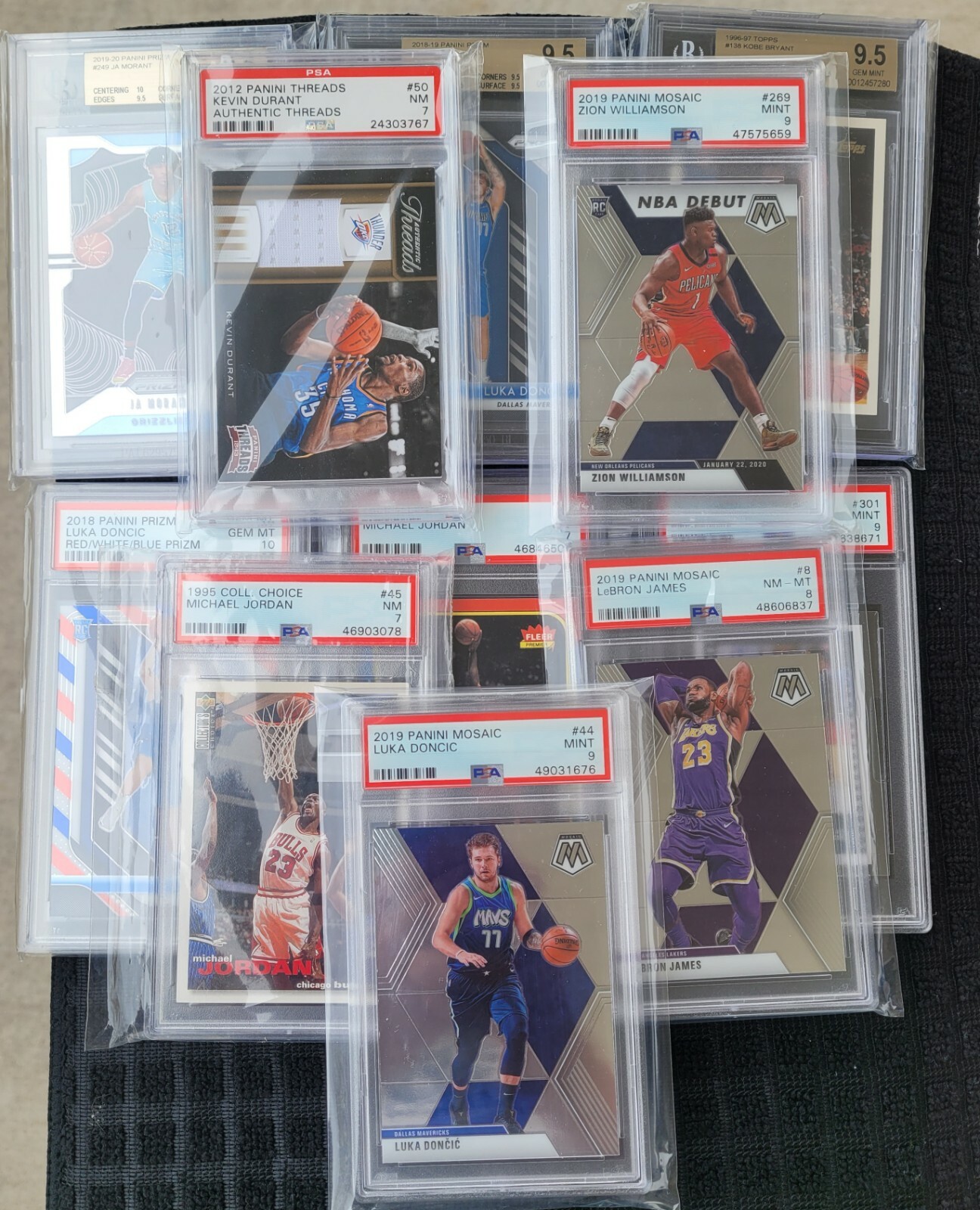

Photos from current listings. Actual item, color, and included accessories may vary.
Psa 10 Basketball Card Buying Guide
PSA 10 basketball cards are professionally graded examples that have earned a Gem Mint 10 from Professional Sports Authenticator, meaning near-perfect centering, corners, edges, and surface under 10x magnification. The core trade-off is grading premium versus raw-card risk: a PSA 10 commands a multiple of the raw price because sub grades below 10 (especially 9) destroy that premium, so the decisive rule is to buy only cards with strong centering (55/45 or better) and pristine surfaces, and to treat any visible flaw as a likely PSA 9.
At a glance
- Category
- Basketball Cards
- Last updated
- Nov 23, 2026
Current offers
Highlights
- PSA 10 requires Gem Mint across four subgrades: centering, corners, edges, and surface; PSA 9 allows minor flaws, so a single soft corner or 60/40 centering can drop a card from 10 to 9.
- Modern PSA 10 populations are often 2-5x higher than vintage PSA 10s, so vintage Gem Mints (pre-1980) carry far greater scarcity and price premiums.
- PSA slab dimensions are standardized at roughly 3.25 x 5.25 inches with a sonically sealed holder; thicker cards (patches, relics) use a thicker slab and must be stored accordingly.
- PSA certification numbers can be verified in the PSA public database; a mismatch between slab label and card (year, set, player, variation) is the most common red flag in resale.
Best use cases
- Best fit: buy PSA 10 for key rookie cards of star players (e.g., LeBron James, Luka Doncic, Victor Wembanyama) where the Gem Mint premium is liquid and resale demand is deep; skip PSA 10 for low-end base cards where grading fees exceed the card's raw value.
- Best fit: choose PSA 10 vintage Hall of Famers (Jordan, Bird, Magic) only when centering is 55/45 or better and surface is clean; skip any vintage PSA 10 with visible print lines or edge chipping, as those are downgrade risks.
- Best fit: for set building or player collections, buy PSA 9 or raw copies and reserve PSA 10 for the single centerpiece card; skip paying PSA 10 premiums on common cards with populations above several thousand.
Buying tips
- Apply the 55/45 centering rule: a PSA 10 should show no worse than 55/45 left-to-right and top-to-bottom; anything approaching 60/40 is a PSA 9 candidate regardless of the label.
- Check the PSA certification number against the PSA database and confirm the card's year, set name, player, and variation match the slab label exactly before buying.
- For vintage cards (pre-1980), expect PSA 10 populations in the single or low double digits; for modern cards, verify population reports because high-pop PSA 10s carry smaller premiums.
- Inspect slab condition: cracks, scuffs, or label peeling reduce resale value and can complicate authentication; a clean, unscratched slab is part of the PSA 10 product.
Specs
| Grade Scale | PSA 10 Gem Mint (1-10 scale) |
|---|---|
| Centering Tolerance | 55/45 front / 60/40 back max |
| Slab Dimensions | ~3.25 x 5.25 in sealed holder |
| Population Factor | Vintage low-pop vs modern high-pop |
Related searches
What to check before buying
- Measure your storage: PSA slabs are about 3.25 x 5.25 inches and require graded-card boxes or sleeves; standard top loaders and 9-pocket pages do not fit.
- Confirm the card's exact variation (base, refractor, parallel, rookie, autograph) because PSA labels distinguish them and price gaps between variations are large.
- Verify the PSA certification number on the PSA website and ensure the slab's label matches the physical card's year, set, and player.
- Check climate: store PSA slabs away from direct sunlight and high humidity (below 60% RH) to prevent card and label degradation.
FAQ
Data sources: eBay / Amazon listings and product attribute feeds. Updated Nov 23, 2026.
Some links on this page are affiliate links. If you buy after clicking one, we may earn a commission at no extra cost to you. This does not change which products appear here or their order. Affiliate disclosure.