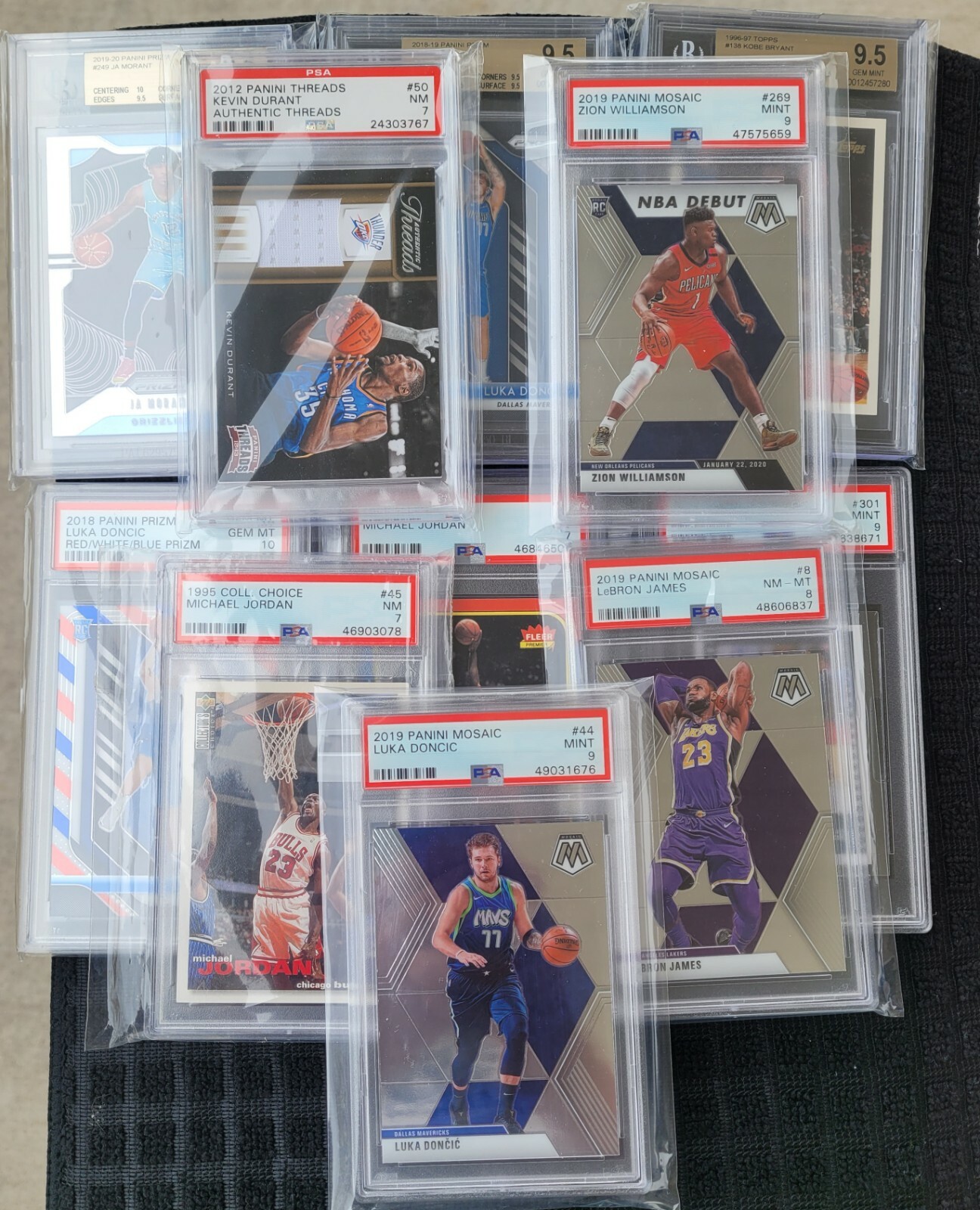

Photos from current listings. Actual item, color, and included accessories may vary.
Nba Graded Card Buying Guide
NBA graded cards are basketball trading cards that have been authenticated and numerically graded by a third-party service, most commonly PSA or Beckett (BGS), then sealed in a tamper-evident slab. The core trade-off is grading rigor versus cost and turnaround: PSA dominates resale liquidity with a 1-10 scale, while BGS offers subgrades and a 0.5-point half-step scale and 10 Pristine tier. The decision rule is simple: buy only slabbed cards with a verifiable certification number and a grade of 9 or 10 for modern stars, and skip raw or unverifiable 'guaranteed sealed' lots unless you are buying for entertainment, not investment.
At a glance
- Category
- Basketball Cards
- Last updated
- Nov 23, 2026
Current offers
Highlights
- PSA uses a 1-10 whole-number scale with qualifiers; BGS uses 0.5 increments plus four subgrades (centering, corners, edges, surface) and reserves 10 Pristine for all four 10s.
- PSA 10 Gem Mint and BGS 9.5 Gem Mint are the primary liquidity tiers; modern-base rookie cards below PSA 9 trade at a steep discount to raw comps.
- Slab security depends on ultrasonic-welded plastic and a unique cert number; PSA and BGS both offer online cert verification, while generic 'guaranteed sealed' repacks carry no such lookup.
- Vintage cards (pre-1980) grade harsher due to print defects and centering; a PSA 8 vintage star often outvalues a PSA 9 modern common by a wide margin.
Best use cases
- Best fit: a specific player or set collector buying a single verified PSA 9/10 or BGS 9.5 rookie—pick the tier that matches your budget and accept that PSA carries broader buyer demand.
- Best fit: a set registry or player PC builder who wants consistent grading—standardize on one grader (PSA or BGS) so grades and slab dimensions stay uniform in storage.
- Wrong fit: buying mystery 'guaranteed graded' repacks expecting a specific card or grade—these are lottery products, not targeted singles; skip them if you need a known asset.
- Wrong fit: submitting low-value base cards for grading—grading fees and shipping typically exceed the card's graded value unless it is a key rookie, short print, or star parallel.
Buying tips
- Match grader to market: PSA for maximum resale liquidity on modern stars; BGS for collectors who value subgrades and the 9.5/10 Pristine half-step tiers.
- Buy the grade, not the label: a PSA 10 with off-center centering under 60/40 still outsells a BGS 9.5 with stronger subgrades in most modern player markets—check centering before corners.
- Verify before you pay: every legitimate slab has a cert number on the label that resolves to a front/back image on the grader's site; a mismatch or missing lookup means walk away.
- For vintage (pre-1980), prioritize eye appeal and centering within the grade; a well-centered PSA 7 often beats a badly centered PSA 8 on resale.
Specs
| Grading Scale | PSA 1-10 whole; BGS 0.5 steps |
|---|---|
| Top Tiers | PSA 10 Gem Mint / BGS 9.5 Gem |
| Slab Security | Ultrasonic weld + cert lookup |
| Best Liquidity | PSA 10 modern NBA rookies |
Related searches
What to check before buying
- Confirm slab dimensions and storage: PSA slabs are roughly 3.25 x 4.5 inches and thicker than BGS; measure your box or display case before committing to a grading standard.
- Check climate and light exposure: keep slabs out of direct sunlight and humid rooms—UV fades ink and humidity can haze slabs over years, so store in a cool, dry cabinet.
- Verify the cert number against the grader's online database and confirm the card year, set, and variation match the label before buying.
- Budget for grading economics: raw submission plus shipping and insurance must be below the expected graded sale value, or buy the card already graded.
FAQ
Data sources: eBay / Amazon listings and product attribute feeds. Updated Nov 23, 2026.
Some links on this page are affiliate links. If you buy after clicking one, we may earn a commission at no extra cost to you. This does not change which products appear here or their order. Affiliate disclosure.