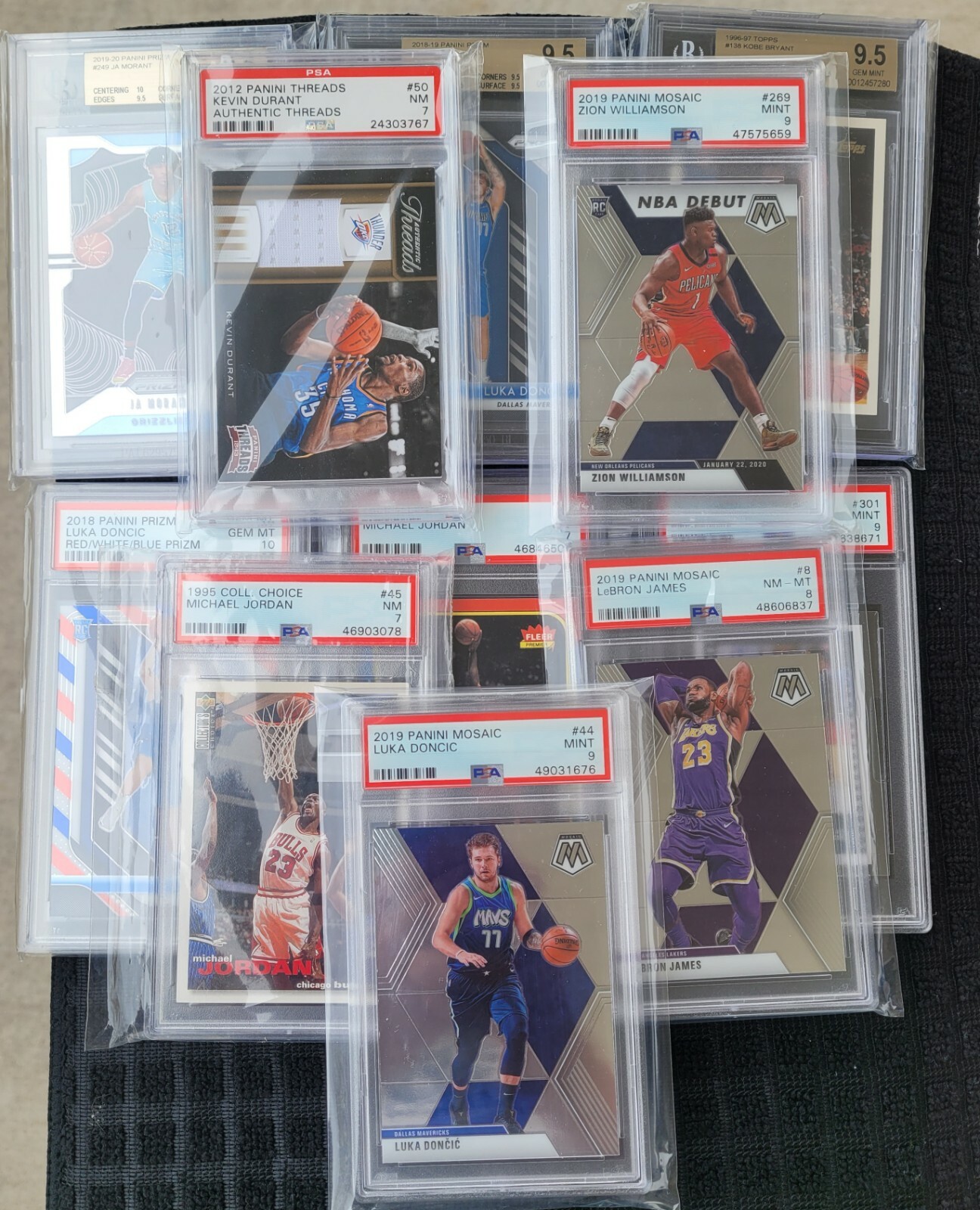

Photos from current listings. Actual item, color, and included accessories may vary.
Graded Basketball Card Buying Guide
Graded basketball cards are authenticated, numerically rated, and encapsulated by third-party services like PSA, Beckett (BGS), or CGC, with the grade and label determining liquidity and value. The primary trade-off is grading rigor versus cost: PSA dominates resale liquidity but has tougher centering standards, while BGS offers subgrades and a tougher gem rate. Buy the holder and grade that match your resale channel and condition tolerance—raw cards only make sense if you can inspect corners and centering yourself.
At a glance
- Category
- Basketball Cards
- Last updated
- Nov 23, 2026
Current offers
Highlights
- PSA uses a 1-10 whole-number scale (PSA 10 Gem Mint, PSA 9 Mint); BGS uses 1-10 with four subgrades (centering, corners, edges, surface) and a 9.5 Gem Mint tier with 10 Black Label Pristine.
- BGS 9.5 typically sells at a discount to PSA 10 for the same card because PSA 10 commands stronger registry and set-builder demand.
- CGC grading is generally stricter on surface and centering, so a CGC 9.5 often cross-grades to PSA 9 or BGS 9.5; CGC 10 is scarce and valued between PSA 9 and PSA 10.
- Slab dimensions are standardized: PSA holders are taller and wider than BGS, so storage boxes and display cases must match the holder brand; PSA slabs fit 4-row shoeboxes, BGS slabs fit 3-row.
Best use cases
- Best fit: buying a PSA 10 rookie card of a Hall of Fame player for long-term hold—PSA 10 has the deepest buyer pool and easiest resale on eBay and at card shows.
- Best fit: buying BGS 9.5 with 10 subgrades for a modern star—subgrade transparency lets you verify centering and surface before purchase, and BGS 9.5 is often cheaper than PSA 10.
- Wrong fit: buying a graded common card or base veteran—grading fees exceed card value, so buy raw or skip; reserve grading for rookies, parallels, autographs, and short prints.
- Wrong fit: buying a slab without checking the cert number on the grader's website—fake slabs and swapped labels exist; always match cert to card and grade before paying.
Buying tips
- Match grade to card era: vintage (pre-1980) cards rarely grade PSA 10 due to print defects, so PSA 8-9 is the practical target; modern cards (post-2010) have higher gem rates, making PSA 10 attainable.
- Check centering before buying any 9 or 10: PSA allows up to 60/40 centering on the front for a 9 and 55/45 for a 10; BGS 9.5 requires 50/50 or better on centering subgrade.
- Buy the holder brand that matches your storage: PSA slabs are 3.25 x 5.25 inches; BGS slabs are 3.5 x 5.5 inches—measure your boxes and cases before committing to a grader.
- For resale, prioritize PSA 10 over BGS 9.5 on the same card unless the BGS has all 9.5+ subgrades; the PSA premium typically exceeds the subgrade advantage.
Specs
| Grading Scale | PSA 1-10 whole; BGS 1-10 with subgrades |
|---|---|
| Top Grade | PSA 10 Gem Mint / BGS 10 Pristine |
| Slab Dimensions | PSA 3.25x5.25 in; BGS 3.5x5.5 in |
| Resale Liquidity | PSA highest; BGS 9.5 discount to PSA 10 |
Related searches
What to check before buying
- Measure your storage: PSA slabs need 4-row boxes (3.25 in wide), BGS slabs need 3-row boxes (3.5 in wide); confirm your case or box fits the holder brand.
- Verify the cert: enter the slab's certification number on PSA, BGS, or CGC's website and confirm the card, grade, and label match exactly.
- Check the card population: look up the card in the grader's population report—a PSA 10 with a population under 50 holds value better than one with 500+.
- Confirm the card is not a reprint or altered: graded cards should have a label noting qualifiers (OC, ST, PD) or evidence of trimming; avoid qualifier grades unless priced at a steep discount.
FAQ
Data sources: eBay / Amazon listings and product attribute feeds. Updated Nov 23, 2026.
Some links on this page are affiliate links. If you buy after clicking one, we may earn a commission at no extra cost to you. This does not change which products appear here or their order. Affiliate disclosure.