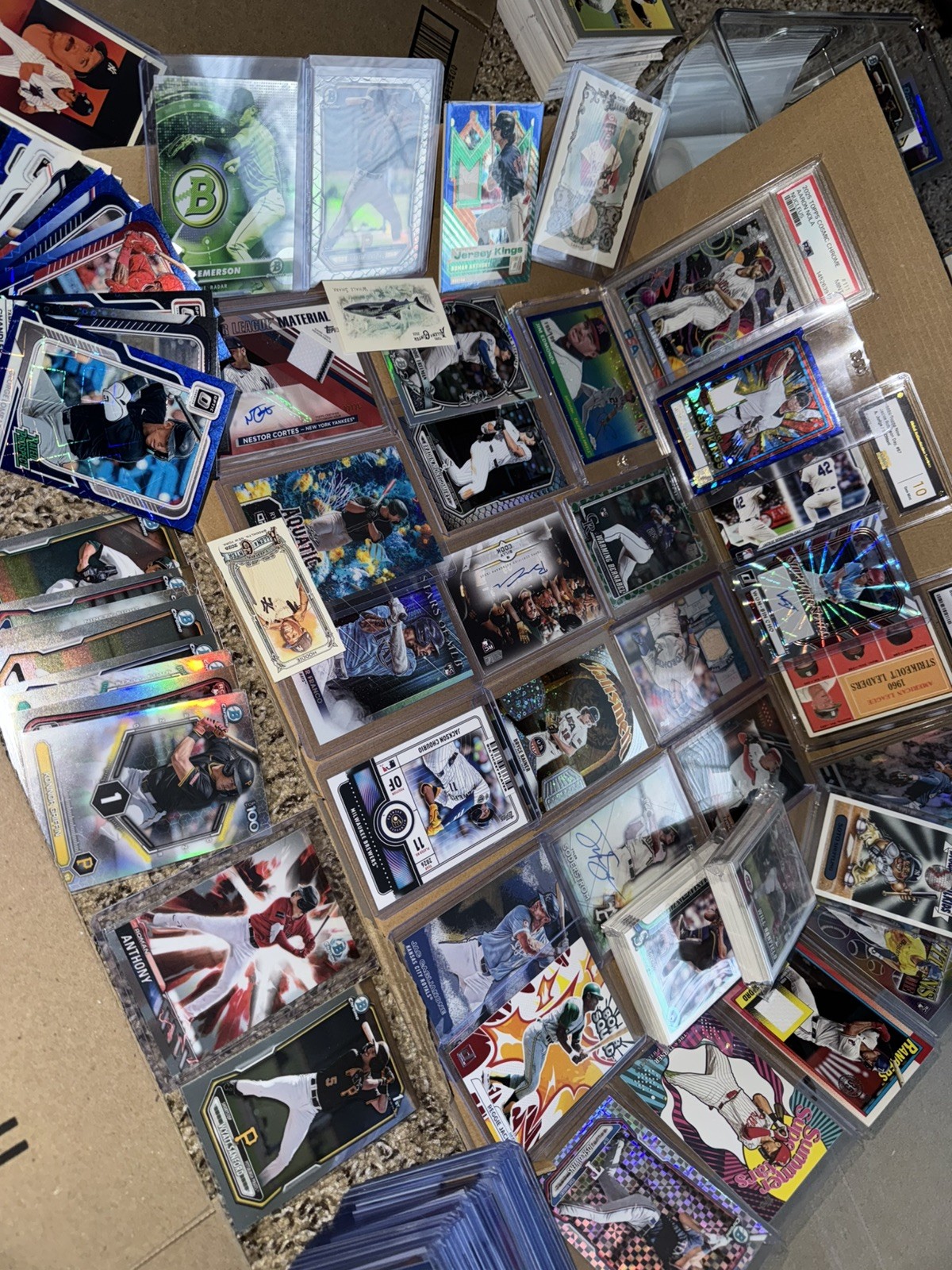

Photos from current listings. Actual item, color, and included accessories may vary.
Rookie Baseball Card Buying Guide
Rookie baseball cards are first-year or prospect-era cards of players before their sophomore season, spanning base paper, chrome/refractor parallels, and autographed issues. The core trade-off is print-run scarcity and condition-grade potential versus low-cost bulk lots that rarely contain gradable stars. The decision rule: buy singles or sealed prospect product for investment-grade rookies; buy bulk lots only for set-building or low-stakes ripping.
At a glance
- Category
- Baseball Cards
- Last updated
- Nov 23, 2026
Current offers
Highlights
- Chrome/refractor rookies carry optically variable foil and serial-numbered parallels; base paper rookies from flagship Update or Series sets have far larger print runs and lower per-card ceiling.
- First Bowman Chrome prospect autographs are the canonical pre-MLB rookie benchmark; flagship RC logos appear only after a player exhausts rookie eligibility, creating two distinct tiers.
- Grading uplift depends on centering within 60/40, sharp corners, and clean surfaces; raw bulk-lot rookies rarely meet PSA 9-10 thresholds due to edge wear and print defects.
- Bulk lots advertised as '1 of 1s, memorabilia, autos, graded' are overwhelmingly low-end hits, reprints, or non-star rookies; true star autographs and numbered parallels are not distributed in volume lots.
Best use cases
- Best fit: buy a single raw or graded flagship RC of a specific player when you have a named target; skip mixed lots that dilute value across unknown names.
- Best fit: buy sealed prospect/Chrome boxes or cases to chase first Bowman autographs at release; skip repack lots marketed as 'guaranteed hit' because hit quality is not enforceable.
- Best fit: buy bulk rookie lots for set-building, trade fodder, or low-cost ripping with kids; skip them for investment because star and numbered cards are filtered out before resale.
- Best fit: collect base paper rookies of established stars for display; skip Chrome parallels if your goal is a low-cost complete rookie run across a year's class.
Buying tips
- Match the card to the player's status: flagship RC logo cards for established MLB rookies; Bowman Chrome 1st autos for prospects still in the minors.
- Check serial numbering and parallel tier: base refractor, numbered /499-/250, and low-numbered colors carry step-change scarcity; unnumbered base chrome is the floor.
- Grade only cards with centered fronts, four sharp corners, and no surface scratches; bulk-lot cards typically fail centering and edge checks, so expect raw-only value.
- Prefer team and year specificity over 'rookie lot' phrasing; a 60- or 100-card lot without named players is a lottery, not a rookie investment.
Specs
| Rookie Type | Flagship RC vs Bowman 1st prospect |
|---|---|
| Parallel Tier | Base / Refractor / Numbered / Superfractor |
| Grade Scale | Raw vs PSA/BGS/SGC 9-10 |
| Lot Composition | Named singles vs mixed bulk lots |
Related searches
What to check before buying
- Confirm the player's rookie-eligibility year and set (flagship Series 1/2/Update vs Bowman prospect) so the card is a true RC, not a second-year or prospect insert.
- Inspect photos or scans for centering left-right and top-bottom, corner sharpness, and surface print lines before buying any raw single.
- For graded cards, confirm the slab label matches the card year, set, and grade tier (PSA, BGS, SGC, CGC) and that the case is uncracked.
- For bulk lots, check the stated card count, era, and whether hits are guaranteed named players; assume star autos and low-numbered parallels are absent.
FAQ
Data sources: eBay / Amazon listings and product attribute feeds. Updated Nov 23, 2026.
Some links on this page are affiliate links. If you buy after clicking one, we may earn a commission at no extra cost to you. This does not change which products appear here or their order. Affiliate disclosure.