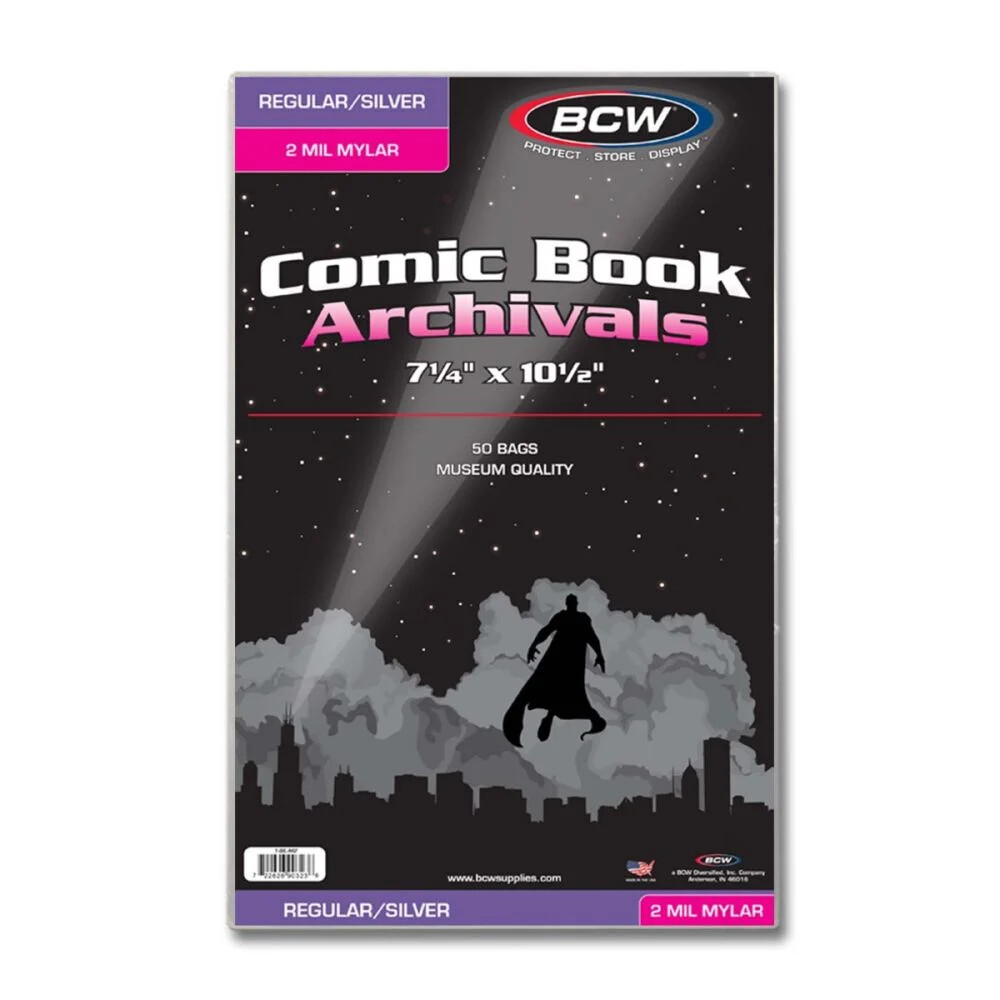

Photos from current listings. Actual item, color, and included accessories may vary.
Mylar Comic Book Bag Buying Guide
Mylar comic bags are polyester (PET) sleeves used to store comics long-term without acid migration or plasticizer damage. The key trade-off is film thickness, seam construction, and whether the bag is true Mylar (PET) versus polypropylene or polyethylene, which off-gas and yellow over decades. The decision rule: choose 2 mil or thicker polyester with welded seams for permanent archive storage; choose 1 mil polyester or poly bags only for short-term reading copies.
At a glance
- Category
- Comic Bags & Backing Boards
- Last updated
- Nov 23, 2026
Current offers
Highlights
- Mylar is a trade name for biaxially-oriented PET; true archival bags are uncoated polyester with no plasticizers, unlike PVC or polypropylene.
- 2 mil polyester is the archival benchmark for Silver Age and standard-size comics; 4 mil is used for oversized annuals and heavy handling.
- Welded or heat-sealed seams resist splitting; glued seams and side-weld bags are more prone to separation under stacking pressure.
- Polyester bags are inert and pass the Photographic Activity Test (PAT); polyethylene and polypropylene bags do not meet archival longevity standards.
Best use cases
- Best fit: Silver Age and Bronze Age comics (roughly 1956–1980s) stored long-term — use 2 mil Mylar bags sized 7 1/4 x 10 1/2 inches with acid-free backing boards.
- Best fit: High-value key issues kept in a climate-controlled room — pair 2 mil Mylar with full-back backing boards to prevent spine roll and corner blunting.
- Wrong fit: Modern comics read weekly and stored short-term — standard polypropylene bags with flaps are cheaper and adequate for under five years.
- Wrong fit: Oversized annuals or treasury editions — standard 2 mil Silver Age bags will crease the corners; use 4 mil oversized Mylar instead.
Buying tips
- Measure the comic cover: standard Silver Age bags fit comics up to 7 x 10 1/2 inches; modern bags run about 7 1/8 x 10 1/2 inches, so match the bag to the book era.
- Choose 2 mil for permanent storage and 4 mil for oversized or frequently handled books; 1 mil Mylar is only for short-term protection and tears easily.
- Check the seam type: heat-welded seams are strongest; glued seams can fail when bags are packed tightly in a box.
- Pair Mylar bags with acid-free, lignin-free backing boards — buffered boards suit most comics, but unbuffered boards are safer for photographic covers and some vintage inks.
Specs
| Film Material | Polyester (PET) vs Polypropylene |
|---|---|
| Archival Thickness | 2 mil standard / 4 mil oversized |
| Seam Construction | Heat-welded vs glued side seams |
| Bag Size | 7 1/4 x 10 1/2 in (Silver Age) |
Related searches
What to check before buying
- Measure your comic height and width with a ruler; add 1/8 to 1/4 inch clearance so the bag does not bow the cover.
- Confirm your storage box interior dimensions: standard comic boxes fit 7 1/4 x 10 1/2 inch bags only when bags are not overstuffed.
- Verify room conditions: keep storage below 70°F and 50% relative humidity; Mylar protects from acid but not from moisture or heat warping.
- Check backing board thickness: 24-point boards fit standard bags; 28-point or thicker boards may require the next bag size up.
FAQ
Data sources: eBay / Amazon listings and product attribute feeds. Updated Nov 23, 2026.
Some links on this page are affiliate links. If you buy after clicking one, we may earn a commission at no extra cost to you. This does not change which products appear here or their order. Affiliate disclosure.